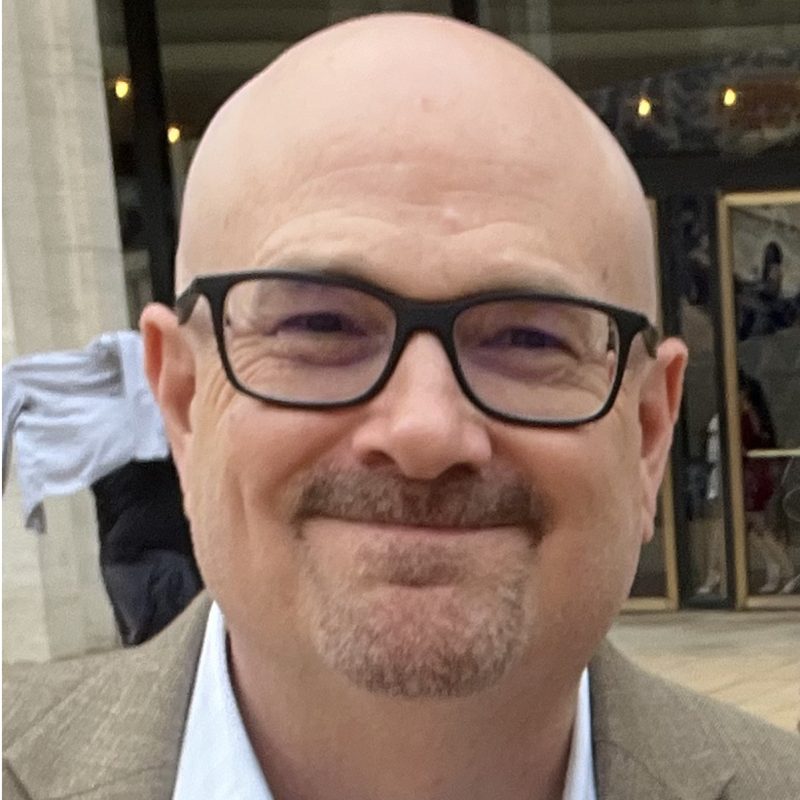
Joe Frericks
I spent thirty years building autonomous systems that had to make correct decisions in milliseconds, with incomplete information and lethal consequences for being wrong — so when I look at how we’re aligning AI, I’m not a tourist. Mine was the discipline of making machines decide correctly under stakes. That’s the lens I bring to the question the AI conversation keeps skipping past: not what we can make these systems do, but what they’re for.
Joe Frericks is a Principal Engineering Fellow and retired chief engineer from Raytheon Missile Systems, where over two decades he designed the guidance and sensing systems that let autonomous weapons perceive, discriminate, and act in real time — the unforgiving version of the problem the AI field now calls alignment. Recognized within Raytheon as a leading authority in RF guidance section design, and one of the vanishing few who can take a system from a blank page through a fielded product. He led Ultra, Raytheon’s composable common-electronics package — publicly reported to be fielded across more than ten weapons programs — from concept through design, build, test, and demonstration.
He led engineering organizations of up to 300 people, and holds an MSEE from Rensselaer Polytechnic Institute and a BSEE from Missouri S&T (formerly the University of Missouri–Rolla). He is the creator and host of The Telos of AI, a podcast asking what AI is actually for, and the principal behind Forces of Good Publishing. A systems engineer by training and a philosopher by obsession, he came to the question his discipline was never built to answer.
The AI conversation is full of people who have never built a machine that had to work. Joe spent thirty years on the unforgiving version of the problem now called alignment: systems that sense a chaotic environment, discriminate the right target from the noise, and act autonomously in real time, where a wrong decision is catastrophic. He isn’t a tourist on machine decision-making — he shipped it, under stakes, for a career. That’s the standing he brings to a simpler, older question the discourse keeps skipping: not what these systems can do, but what they’re for.
A thought-provoking story of human disconnectedness in the age of AI and the consequences of the technology we build. Frericks imagines a future with echoes in the present. You’ll read it quickly but it will stay with you much longer!
Professor of Computer Science, University of Massachusetts Amherst
Joe was appointed Principal Engineering Fellow — Raytheon’s top technical-track grade — on the nomination of his supervisor, Laura J. McGill, then Raytheon’s Vice President of Engineering and now Director of Sandia National Laboratories. The career history below is corroborated on his public LinkedIn profile.